
Online Marketing
Every other marketing channel you use is rented. Your ad account can be suspended, your organic rankings can drop overnight, and your social reach is decided by an algorithm that owes you nothing. Your email list is the only audience you actually own, and for most small businesses it is also the cheapest one to reach. This playbook covers what email marketing for small business actually requires in 2026: how to build a list that converts, which five automated emails do most of the work, what it costs, and the deliverability rules that changed and quietly broke a lot of campaigns.
What Is Email Marketing for Small Business, and Why Does It Still Work?
Email marketing for small business is the practice of collecting permission based contact information and sending targeted messages that drive purchases, repeat visits, and referrals. It works because email is owned media: you reach subscribers directly without paying for placement, and it consistently returns more revenue per dollar than paid social or display advertising. Litmus research puts the figure near 36 dollars returned for every dollar spent.
That number gets quoted so often it has lost meaning, so here is the part that matters more. Email is the only channel where cost stays flat while revenue scales. A Google Ads budget doubles when you want twice the clicks. An email list of 4,000 costs almost exactly what a list of 2,000 costs, and it earns roughly twice as much. That is the entire argument, and it is why the businesses that commit to a list for eighteen months rarely go back.
The catch is that email rewards consistency and punishes bursts. Sending four campaigns in one week after nine months of silence produces spam complaints, not sales. The playbook below is built around that reality.
Build the List Before You Build the Campaign
Most small businesses skip straight to designing a newsletter template and then discover they are sending it to 180 people, half of whom are vendors. List building is the unglamorous work that determines everything downstream. Four mechanisms account for the overwhelming majority of quality subscribers.
| 01 | Offer something worth an email address. A generic “sign up for our newsletter” box converts around one percent of visitors. A specific, useful asset tied to what you sell converts several times better. A contractor offers a renovation budget worksheet. A dental practice offers a first visit checklist for anxious patients. The asset should be genuinely useful on its own, because it is the first sample of your work a prospect ever sees. |
| 02 | Capture at the point of transaction. The single highest intent moment in your business is checkout, booking confirmation, or invoice. Someone who just paid you is far more likely to opt in than a cold visitor. Add the checkbox there, keep it unchecked so consent is real, and make the value explicit: order updates, care instructions, member only pricing. |
| 03 | Use exit intent sparingly and honestly. One well timed offer as a visitor leaves a product or service page will meaningfully lift signups. Three stacked popups on a first visit will lift bounce rate instead. If you run one, suppress it for anyone already subscribed and for anyone who dismissed it in the last thirty days. |
| 04 | Never buy or scrape a list. Purchased lists produce bounce rates and complaint rates that damage your sending reputation permanently, and they violate the terms of every reputable platform. If you want to reach people who have not opted in, that is outbound prospecting, which is a separate discipline with separate rules. We covered how that actually works in our breakdown of why AI cold email works now and why most campaigns fail. |
A list of 800 engaged subscribers who asked to hear from you will outperform a list of 8,000 harvested addresses on every metric that matters, and it will not put your domain reputation at risk. Size is a vanity metric. Engagement is the asset.
The Five Automated Emails That Do Most of the Work
Small business owners assume email marketing means writing a newsletter every week forever. It does not. The majority of revenue in a well built program comes from automated sequences that you write once and that send themselves based on subscriber behavior. Five of them cover almost every business model.
Welcome sequence
Three to five emails delivered over the first two weeks after signup. This sequence consistently earns the highest open rates in any account, because subscribers are at peak interest. Deliver the promised asset immediately, then explain who you are, show one piece of proof, and make one clear offer. Do not save the offer for email seven. People forget you by email three.
Abandoned cart or abandoned inquiry
For ecommerce this is the cart. For service businesses it is the quote request that never got answered, or the consultation form that was started and not submitted. Two emails, sent at roughly one hour and twenty four hours, recover a meaningful share of otherwise lost revenue. Service businesses almost never build this one, which is exactly why it is worth building.
Post purchase and review request
Sent after delivery or after the job is complete, timed to the moment of peak satisfaction. Ask for the review here rather than in person, because a link in an inbox converts better than a verbal request people forget. This sequence feeds directly into local search visibility, which is why it pairs so well with Google Business Profile optimization.
Win back
Triggered when a customer passes their typical repurchase or rebooking window. A dental practice sends it at seven months. A landscaping company sends it in early spring. The message is short and specific: it has been a while, here is what is new, here is a reason to come back now.
Re-engagement and sunset
Subscribers who have not opened anything in six months are actively hurting you, because low engagement signals tell inbox providers your mail is unwanted. Send two attempts to re-engage them, then remove them. Cutting dead weight from a list almost always raises open rates on the next campaign, and it lowers your platform bill at the same time.
Not sure which of these five you are missing?
We map the automations against how your business actually makes money, then build the ones that will pay for themselves first. It is part of how we approach online marketing services for growing businesses.
How Much Does Email Marketing Cost for a Small Business?
Email marketing software for a small business typically costs between 0 and 150 dollars per month, priced by subscriber count rather than by send volume. Most businesses under 2,500 subscribers pay less than 45 dollars per month. The real cost is not the platform. It is the time or the fee required to write and design the emails.
Here is what the platform line item looks like across common list sizes in 2026.
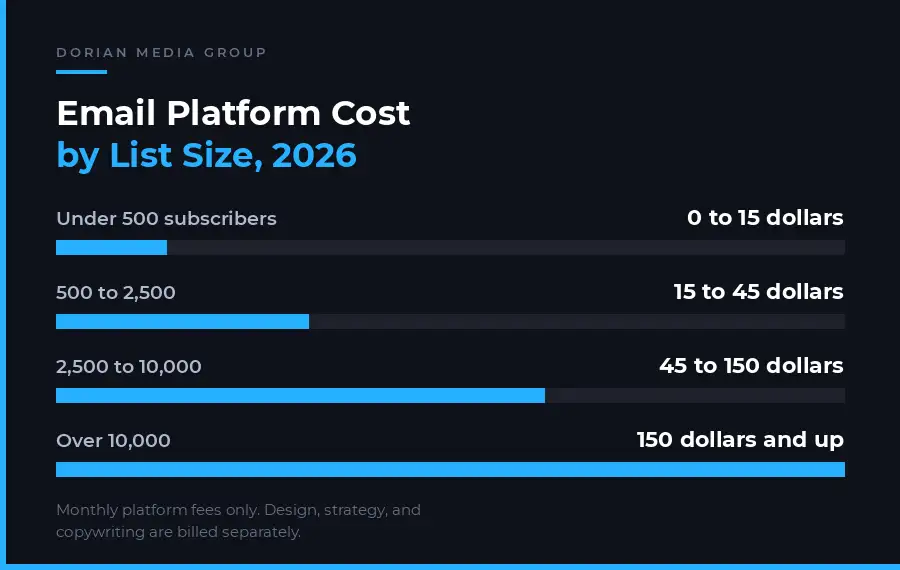
| List size | Typical monthly cost | What you get at this tier |
|---|---|---|
| Under 500 | 0 to 15 dollars | Free tiers are genuinely usable here. Expect send limits and platform branding in the footer. |
| 500 to 2,500 | 15 to 45 dollars | Full automation builders, segmentation, and A/B testing. This is where most small businesses live. |
| 2,500 to 10,000 | 45 to 150 dollars | Advanced segmentation, predictive send timing, and ecommerce revenue attribution. |
| Over 10,000 | 150 dollars and up | Dedicated IP options, deliverability support, and custom send infrastructure. |
One pricing trap deserves a warning. Nearly every platform bills on total contacts stored, including unsubscribed and inactive addresses. Businesses routinely pay a higher tier for years because 3,000 dead contacts are sitting in the account. Clean the list quarterly and the bill drops on its own.
Deliverability: The Rules Changed and Most Senders Did Not Notice
This is the section that saves campaigns. In February 2024, Google and Yahoo introduced enforced requirements for bulk senders, and the standard has only tightened since. If your email is landing in spam and you do not know why, the cause is almost always on this list.
✓ Authenticate your domain with SPF, DKIM, and DMARC. These are DNS records that prove you are allowed to send from your domain. Missing DMARC alone is enough to get filtered. Google publishes the full requirements in its email sender guidelines.
✓ Send from your own domain, never from a free address. Mail from a gmail.com or yahoo.com sender address through a marketing platform now fails authentication checks outright.
✓ Keep spam complaints below 0.3 percent. That threshold is roughly three complaints per thousand delivered messages. Crossing it consistently gets your mail throttled or blocked.
✓ Support one click unsubscribe. The unsubscribe must work in a single click and be processed within two days. Reputable platforms handle this automatically, but only if you use their footer rather than a custom one.
✓ Include a real physical postal address. This is a legal requirement in the United States under the CAN-SPAM Act, and the FTC compliance guide spells out the rest, including honoring opt outs within ten business days.
✓ Warm up a new sending domain gradually. Sending to 5,000 addresses on day one from a domain with no history is the fastest way to get flagged. Start small and increase volume over two to three weeks.
The United States Small Business Administration also publishes a useful primer on email marketing basics for small business if you want a second reference point on the fundamentals.
How Do You Know Whether Email Marketing Is Working?
Judge email marketing on revenue per subscriber and click through rate, not on open rate. Apple Mail Privacy Protection has inflated opens since 2021 by preloading images, which means a meaningful share of recorded opens never happened. Clicks, replies, and revenue are the metrics that still tell the truth.
| Metric | Healthy range | What it tells you |
|---|---|---|
| Click through rate | 2 to 5 percent | Whether your offer and audience actually match. The most honest single number in the report. |
| Unsubscribe rate | Under 0.5 percent | Whether your frequency and relevance are sustainable. A spike means you sent to the wrong segment. |
| Spam complaint rate | Under 0.1 percent | Your margin before inbox providers start filtering you. The hard ceiling is 0.3 percent. |
| Bounce rate | Under 2 percent | List hygiene. Anything higher suggests old data or an acquisition source you should stop using. |
| Revenue per subscriber | Track your own trend | The only metric that answers whether the channel is worth the effort. Benchmarks are useless here. |
In the accounts we manage, the pattern is consistent: the first ninety days produce modest campaign revenue and the automations produce almost none, because there is not enough list volume flowing through them yet. Somewhere between month four and month six the automated sequences quietly overtake the broadcast campaigns and stay ahead permanently. Owners who quit at month three almost always quit right before the compounding starts.
Five Mistakes That Quietly Kill Small Business Email Programs
✓ Sending the same email to the entire list every time. A customer who bought last week and a subscriber who downloaded a guide in March should not receive identical messages. Even two segments beat one.
✓ Writing subject lines for cleverness instead of clarity. Vague and playful subject lines lose to specific ones in nearly every test. Tell people what is inside.
✓ Designing image heavy emails. Many clients block images by default, so an email that is one large graphic arrives as a blank rectangle. Lead with text and let images support it.
✓ Burying a single call to action at the bottom. One clear action, repeated two or three times, outperforms a message with five competing links every time.
✓ Treating email as a standalone channel. Email works hardest when it is fed by everything else you do. If you are running lean, our guide to promoting your business without a marketing team covers how the pieces fit together.
Frequently Asked Questions
What is the best email marketing platform for a small business?
The best platform is the one whose automation builder you will actually use. For businesses under 1,000 subscribers who want a generous free tier and a simple interface, MailerLite and Brevo are the common picks. Mailchimp offers the largest template library but gets expensive as the list grows. Klaviyo is the standard for ecommerce because of its revenue attribution. Choose based on automation depth and pricing at the list size you expect in twelve months, not the size you have today.
How often should a small business send marketing emails?
Twice a month is the safe starting point for most small businesses, moving to weekly once you have a reliable content supply. Consistency matters more than frequency. A predictable monthly email outperforms an erratic schedule that swings between four sends in a week and three months of silence, because inbox providers and subscribers both reward predictable sending patterns.
Is email marketing still effective in 2026?
Yes, and its relative advantage has grown. As paid acquisition costs rise and organic social reach declines, owned audiences have become more valuable, not less. Email remains the only major channel where you control distribution and where the cost of reaching an additional subscriber is effectively zero. The requirements to do it well have tightened, particularly around authentication, but the economics have improved.
How big does an email list need to be before it is worth the effort?
Around 300 to 500 engaged subscribers is the point where campaign results become statistically meaningful rather than noisy. That said, the automations are worth building on day one regardless of list size, because a welcome sequence sending to five people a week costs nothing extra and compounds from the moment it exists.
What is the difference between email marketing and cold email?
Email marketing sends to people who gave you permission, using your primary domain and a marketing platform. Cold email sends to prospects who have not opted in, and it requires separate sending domains, different infrastructure, and different legal considerations. Mixing the two on one domain is the fastest way to destroy the deliverability of both.
Why are my emails going to spam?
The most common causes, in order: missing DMARC or DKIM authentication records, sending from a free address such as gmail.com, a spam complaint rate above 0.3 percent, sudden volume spikes from a cold domain, and continuing to mail subscribers who have not opened anything in over a year. Fix authentication first, because it accounts for the majority of cases.
Your list is the one audience nobody can take from you.
Dorian Media Group builds email programs that run on their own: the automations, the segmentation, the authentication setup, and the reporting that tells you what it is actually worth. If email has been on your list of things to get to for a while, this is the part we take off your plate.
In this article

Written by
DORIAN MEDIA GROUP
Dorian Media Group is a creative AI agency and production company that unifies brand strategy, premium content, website design, and AI powered marketing into one cohesive system built to grow your business.

Social Media Channels