
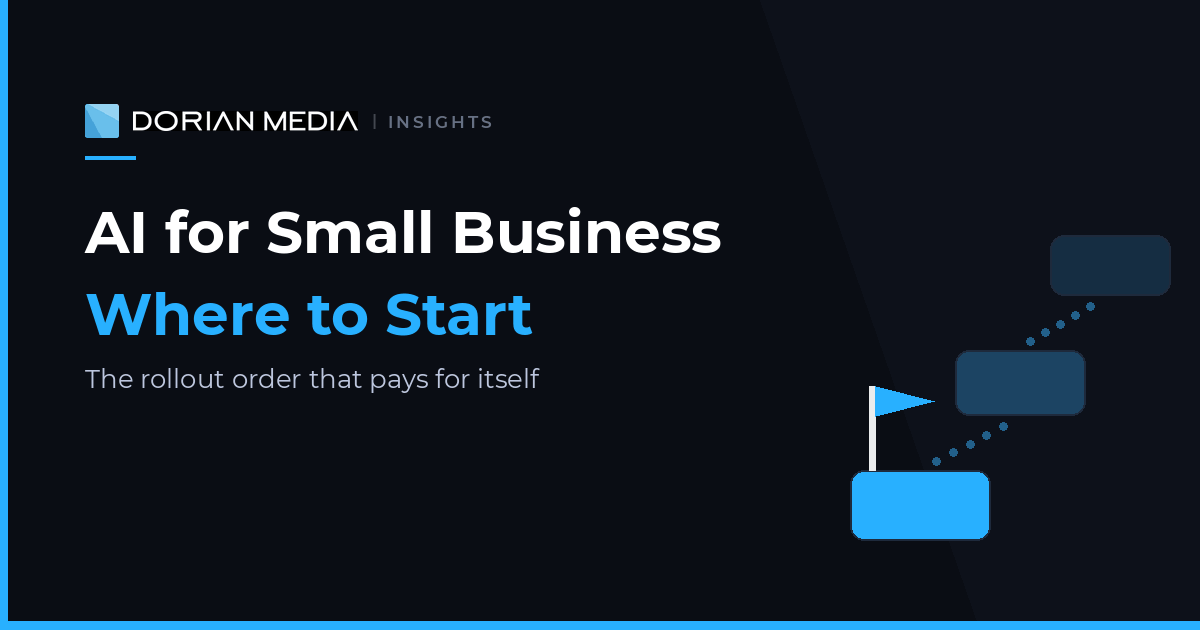
AI and Automation
AI for small business works best when you start where money already leaks: unanswered calls, slow follow up, and hours lost to repetitive admin. Not with some grand overhaul plan. This guide walks through what AI can realistically do for a small company in 2026, the order we implement it in for clients, what each stage costs, and the hype you can safely ignore.
What Can AI Actually Do for a Small Business?
AI helps small businesses in four practical areas: answering and qualifying customer inquiries around the clock, automating repetitive admin like scheduling and data entry, producing first drafts of marketing content, and pulling useful answers out of the data you already collect. Everything else is a variation on those four jobs.
The important shift in 2026 is that none of this requires a technical team anymore. Conversational agents handle real customer conversations on your website and phone line. Automation platforms connect the tools you already pay for. Language models draft emails, proposals, and posts that a human then edits. Surveys by the U.S. Chamber of Commerce consistently find that most small businesses using AI report time savings and a majority say it helps them compete with larger companies, and that matches what we see with our own clients.
What AI does not do is run your business for you. It compresses labor and response time. Judgment, offers, and relationships stay human. Businesses that get the best results treat AI as a tireless junior employee with excellent recall and zero initiative.
Why Most Small Businesses Start in the Wrong Place
The most common mistake we see is starting with tools instead of problems. A business owner reads about ten AI apps, subscribes to three, uses each for two weeks, and concludes AI is overhyped. The subscriptions were never the issue. Nothing was aimed at a measurable leak in the business.
The second mistake is starting with the hardest project first, usually something ambitious like a fully automated sales pipeline or a custom trained model. Those projects fail without clean processes underneath them. When we run assessments for clients, the highest ROI opportunity is almost always mundane: inquiries that wait hours for a reply, appointment scheduling that takes three back and forth emails, or invoices chased manually every month. Fixing one of those pays for the next project, and momentum matters more than ambition in the first ninety days.
Where Should a Small Business Start With AI?
Start with response time on the demand you already have, then automate the admin behind it, then expand into marketing and data. This is the sequence we use in client engagements because each step funds the next one.
| 01 | Capture the leads you already earn. An AI chat or voice agent that answers every inquiry in seconds, asks two qualifying questions, and books directly into your calendar. This is the fastest payback in all of small business AI, and we covered the full system in our guide to AI lead generation that works right now. |
| 02 | Automate the follow up and admin behind those leads. Automatic reminders, review requests, quote follow ups, and data entry between your calendar, CRM, and invoicing tools. Ten to fifteen hours a month come back for a typical service business. |
| 03 | Put AI behind your marketing. Drafting email campaigns, social posts, and page copy with a human edit on top; our guide to ChatGPT for small business covers the exact use cases that pay off here. Output goes up three to five times without hiring, as long as someone with taste still approves what ships. |
| 04 | Ask questions of your own data. Which services are most profitable, which lead sources convert, where jobs run over budget. This stage comes last because it depends on the clean records the first three stages create. |
Not sure which stage your business is in?
The Dorian Media Group $997 AI Opportunity Audit maps where hours and leads leak in your specific operation and hands you a prioritized plan with real costs, whether or not we build any of it.
How Much Does AI Cost for a Small Business?
Most small businesses get meaningful results for between $50 and $500 a month in tools, plus a one time setup investment of $2,000 to $10,000 if you want the system configured professionally. Off the shelf chat and scheduling tools sit at the bottom of that range. Configured agents trained on your services, connected to your calendar and CRM, sit in the middle. Custom automation across several systems sits at the top.
The setup investment is where owners hesitate, and it is also where the return concentrates, because an agent that knows your pricing, your service area, and your booking rules performs completely differently from a generic widget. We broke down advisory and implementation pricing in detail in our guides to AI consultant costs and engagement types and AI chatbot pricing and ROI. As a rule of thumb, if a system cannot plausibly recover its monthly cost in one saved booking or five saved hours, skip it.
What Should Small Businesses Skip?
Skip anything sold as fully autonomous, and skip building custom AI where a configured off the shelf tool already works. Three specific traps come up constantly in our audits.
| ✓ | Tool stacking. Five overlapping subscriptions used at ten percent each. Pick one tool per job and configure it properly before adding anything. |
| ✓ | Unsupervised customer contact. An agent that quotes wrong prices or promises services you do not offer creates real liability. Keep a human approving anything that touches money or commitments. |
| ✓ | Publishing raw AI content. Unedited AI text reads generic, and search engines increasingly reward first hand experience. Use AI for drafts and structure, keep your voice and your specifics. |
If you would rather have one team scope, build, and manage the whole sequence, that is exactly what our AI consulting services cover, from the first assessment through implementation.
How Long Until AI Shows Results?
Expect the first stage to show results within two to four weeks, because a capture agent works on visitors and callers you already have. In client deployments, the clearest early signal is after hours bookings: appointments that appear on the calendar from inquiries that previously went to voicemail. If your business misses even one call a day, that signal usually shows up in the first week.
Automation savings build more gradually. The hours come back in small pieces, a reminder here, a data entry task there, and most owners only see the full picture when they compare a month of admin time before and after. We ask clients to track one number per project, missed calls, hours on scheduling, or days from invoice to payment, so the return is visible instead of vibes. Content and data projects run on quarterly horizons, since search rankings and reporting habits both take time to compound.
A realistic ninety day arc for a service business looks like this: capture agent live and booking by week three, follow up and admin automation running by week eight, and a first pass at AI assisted marketing by week twelve. Budget somewhere between $3,000 and $8,000 across that arc for professional setup, and hold every project to the same test, one recovered booking or five recovered hours per month, minimum.
Frequently Asked Questions
How can a small business start using AI?
Start by fixing response time on inquiries you already receive: an AI chat or voice agent that answers instantly and books appointments. Then automate follow up and repetitive admin, then use AI to draft marketing content. Each stage pays for the next and none requires technical staff.
Is AI worth it for a small business?
Yes, when it targets a measurable leak like missed calls, slow follow up, or hours of manual admin. A system that recovers one booking or five hours a month usually covers its cost. AI adopted as a general experiment, with no specific problem attached, is rarely worth it.
How much does AI cost for a small business?
Typical budgets run $50 to $500 per month in tools, plus $2,000 to $10,000 one time if you want agents and automations professionally configured for your services, calendar, and CRM. Simple off the shelf tools sit at the low end, custom multi system automation at the high end.
What is the best AI tool for small business?
There is no single best tool because capture, automation, and content are different jobs. The best stack for most service businesses pairs a conversational agent on the website and phone with an automation platform connecting calendar, CRM, and invoicing. Fit with your sales process matters more than brand names.
Will AI replace employees in a small business?
In most small businesses AI absorbs tasks rather than jobs: after hours phone coverage, data entry, first draft writing, and follow up scheduling. Owners typically redirect the recovered hours into billable work and sales. Judgment, relationships, and quality control stay with people.
Dorian Media Group
Start with the AI that pays for itself first
Most owners need two or three systems that plug the leaks in their specific business, not ten tools. Dorian Media Group scopes, builds, and manages AI for small businesses in the exact order it produces return.
In this article

Written by
DORIAN MEDIA GROUP
Dorian Media Group is a creative AI agency and production company that unifies brand strategy, premium content, website design, and AI powered marketing into one cohesive system built to grow your business.
Social Media Channels